Concise Summary简洁概述
Nate Soares argues that the human brain is constitutionally incapable of feeling the difference between caring about a million people and caring about a billion people — the internal "care-o-meter" saturates far too early. This scope insensitivity means that prominent altruists are not people who feel more intensely than the rest of us; they are people who have stopped trusting their feelings to guide action. Once you do the math — multiply a small but genuine unit of care by the enormous scale of the world's problems — you realize you already care far more than your gut lets on, and that the real constraint is not motivation but the sheer impossibility of doing enough. The right response is not guilt, but a kind of calm desperation: act like the stakes are as large as they actually are, even when you can't feel that they are.
Nate Soares 指出,人类大脑在结构上就无法感受关心一百万人与关心十亿人之间的差距——内在的「关怀计量表」远在需要之前就已饱和。这种「规模不敏感」意味着,杰出的利他主义者并非比我们感受更强烈的人,而是不再信任感受来指导行动的人。一旦你做了乘法——把一个微小但真实的关怀单位乘以世界问题的庞大规模——你就会意识到,你其实比直觉所呈现的关心得多得多,真正的瓶颈不是动力,而是根本不可能做得够多。正确的回应不是愧疚,而是一种平静的紧迫感:即使无法感受到,也要按照世界问题的真实规模去行动。
Infographic信息图
The broken care-o-meter
坏掉的关怀计量表
A million and a billion feel almost the same emotionally. Our caring hardware was built for ~150 people and simply cannot scale to billions.
一百万和十亿在情感上几乎感觉一样。我们的关怀硬件是为约150人设计的,根本无法扩展到数十亿。
Shut up and multiply
闭嘴,做乘法
Instead of asking your gut how much you care, find your unit value for one case, then multiply by the true scale. The result is often terrifying.
不要问直觉你关心多少,而是找出你对一个案例的单位价值,再乘以真实规模。结果往往令人震惊。
The mental shift
思维转变
Before the shift: problems don't seem pressing enough. After: everything is your problem and there are just too many mountains to climb.
转变前:问题显得不够迫切。转变后:一切都是你的问题,只是山太多,根本爬不完。
Caring is acting, not feeling
关怀是行动,不是感受
Like courage — which isn't fearlessness but doing right while afraid — caring about the world means acting on scale even when you can't feel that scale.
如同勇气——不是无所畏惧,而是恐惧中仍然行事——关怀世界意味着即使感受不到规模,也要按规模行动。
Not guilt, but desperate clarity
不是愧疚,而是清醒的紧迫
Soares explicitly rejects guilt as a motivator. The goal is a calm, proud recognition that the stakes are astronomically high and we act anyway.
Soares 明确拒绝以愧疚为动力。目标是平静而自豪地认识到赌注高得惊人,并依然行动。
Detailed Summary详细概述
1. The hardware problem
Soares opens by confessing that once numbers exceed about 1,000, they all feel roughly "big." A star the size of a million Earths and a star the size of a billion Earths produce almost identical emotional responses. This is not a personal failing — it is a feature of human neurology. The brain can grasp "four apples feels like twice as many as two," but it cannot grasp a magnitude differential of 10^91 in any gut-level way. This phenomenon is scope insensitivity.
The stakes are not abstract. Billions of people live in poverty; hundreds of millions lack basic needs or die from disease. Soares says he cares about every one of them — but his care-o-meter was calibrated by evolution to handle roughly 150 people, and it simply does not go higher.
2. The courage analogy
Courage is not fearlessness; it is doing the right thing despite fear. By analogy, caring about the world is not about having a feeling proportionate to the world's suffering — it is about doing the right thing even without that feeling. Our internal caring heuristics utterly fail at the scale of billions. Saving one life would feel about as good as saving the world, because the hardware cannot express a feeling a billion times larger. But behind those similar feelings lies a world of difference that demands different action.
3. Social donations vs. the mental shift
Soares introduces Alice, Bob, and Christine — three people who donate to charity largely driven by social pressure, guilt, or competitive camaraderie. Their giving is real and good, but it is anchored to social context rather than the actual content or scale of suffering. If pressed on why they don't give everything, they'd find the question strange — it simply isn't how one thinks about money.
Then there is Daniel. After the Deepwater Horizon spill, he encounters a charity soliciting for oiled-bird rescue. He resists the usual dismissal ("not the most important thing") and does a sanity check. He imagines a bird at his feet: he would give 3 minutes or $3 to save it. But because he knows his brain lies about large numbers, he shuts up and multiplies. Thousands of birds were oiled. Therefore, he actually cares about this to the tune of tens of thousands of dollars and months of time.
Then he applies the same logic to factory farming, global poverty, disease, war, the future of civilization — and realizes he actually cares about all of these causes to the tune of vastly more than he possesses. He can no longer give $3 to the bird fund, not because birds aren't worth it, but because the opportunity cost is too high: there are too many other mountains.
4. The new mindstate
In the old mindstate, problems didn't seem pressing enough to act on — the idea of dropping everything for ALS never crossed the mind as a real option. In the new mindstate, everything is Daniel's problem; the only reason he isn't working on ALS is that 99 bigger problems come first. The contrast between Alice/Bob/Christine and Daniel is not one of virtue but of seeing: the former donate when reminded; the latter can never forget.
5. Switching to manual control
Soares is explicit that he is not preaching guilt or demanding everyone become a philanthropist (he notes it is "really really hard" and that guilt is a poor long-term motivator). What he is pointing at is a switch: stop trusting the care-o-meter to guide action, and switch to manual control. You will never feel the appropriate amount of urgency. The world's problems are too large for human hardware. But you can still act as if the stakes are as large as they are.
The essay closes with the same courage structure it opened with: Gandhi, Mother Teresa, Mandela probably didn't feel more than we do — they just stopped trusting their feelings. Do the multiplication; trust the numbers over the feelings; because our feelings lie to us.
You can't actually feel the weight of the world. The human mind is not capable of that feat. But sometimes, you can catch a glimpse.
一、硬件问题
Soares 开篇便承认,一旦数字超过约1000,它们在感受上都只是「很大」。一颗体积等于一百万个地球的星星,与一颗等于十亿个地球的星星,在情感上几乎没有区别。这不是个人缺陷,而是人类神经系统的特征。大脑能够感知「四个苹果是两个苹果的两倍」,但无法在直觉层面感知10^91级别的数量差。这一现象叫做「规模不敏感」。
这不是抽象的问题。数十亿人生活在贫困中,数亿人缺乏基本需求或死于疾病。Soares 说他关心每一个人——但他的关怀计量表是由进化校准的,大约只能处理150人,再往上就到头了。
二、勇气类比
勇气不是无所畏惧,而是即使害怕也做正确的事。类比地,关怀世界不是要有一种与世界苦难相称的感受——而是即使没有那种感受,也要做正确的事。我们内在的关怀启发式,在面对数十亿人的规模时彻底失效。拯救一条生命的感受,和拯救整个世界的感受差不多——因为硬件无法表达比前者大十亿倍的感觉。但在那些相似的感受背后,藏着一个需要截然不同行动的世界级差异。
三、社会性捐款 vs. 思维转变
Soares 引入了 Alice、Bob 和 Christine——三个主要受社会压力、愧疚感或竞争友情驱动而捐款的人。他们的给予是真实的,也是好的,但它锚定于社会情境,而非苦难的真实内容或规模。如果追问他们为什么不把所有钱都捐出去,他们会觉得这个问题奇怪——人们根本不会这样想钱的问题。
然后是 Daniel。在深水地平线漏油事件后,他遇到一个为除油鸟募捐的志愿者。他抵制了通常的回避(「又不是最重要的事」),决定做个理智检验。他想象脚边有一只鸟:他愿意花3分钟或3美元救它。但因为他知道大脑在大数上会撒谎,他闭嘴,做了乘法。这次漏油共污染了数以千计的鸟。因此,他对这件事的实际关心程度,下限是数万美元和数月时间。
然后他把同样的逻辑应用到工厂化养殖、全球贫困、疾病、战争、人类文明的未来——意识到他对所有这些事业的实际关心程度,都远远超过他所拥有的一切。他再也无法给除油鸟捐3美元,不是因为鸟不值得,而是机会成本太高:还有太多其他的山等着他。
四、新的心态
在旧的心态中,问题似乎还不够迫切——「放弃一切去解决 ALS」这个念头,从未真正作为一个现实选项进入脑海。在新的心态中,一切都是 Daniel 的问题;他没有去解决 ALS 的唯一原因,是有99个更大的问题排在前面。Alice、Bob、Christine 与 Daniel 的区别不在于品德,而在于看见:前者在被提醒时捐款;后者永远无法忘记。
五、切换到手动控制
Soares 明确表示他不是在宣扬愧疚,也没有要求每个人都成为慈善家(他指出这「真的非常难」,而且愧疚是很差的长期动力)。他指向的是一个切换:停止信任关怀计量表来指导行动,切换到手动控制。 你永远不会感受到应有的紧迫感。世界的问题对人类硬件来说太大了。但你仍然可以按照赌注实际的大小去行动。
文章以它开头时的勇气结构作结:甘地、特蕾莎修女、曼德拉可能并不比我们感受更多——他们只是停止了信任自己的感受。做乘法;信任数字胜过感受;因为我们的感受在欺骗我们。
你实际上感受不到世界的重量。人类的心智没有这种能力。但有时,你能瞥见一丝。
FAQ常见问答
What is scope insensitivity and why does it matter here?什么是「规模不敏感」,为什么它在这里如此重要?
Scope insensitivity is the cognitive phenomenon where our emotional responses fail to scale with the magnitude of a problem — a thousand deaths and a million deaths feel roughly equally "terrible." It matters because all moral and altruistic intuitions run through this broken hardware. When we rely on gut feelings to calibrate how much to give or act, we are implicitly trusting a meter that tops out far below the actual scale of the world's problems.
「规模不敏感」是一种认知现象:我们的情感反应无法随问题规模等比例扩大——一千人死亡和一百万人死亡在感受上都只是「很可怕」。它之所以重要,是因为所有道德和利他主义的直觉都要经过这套坏掉的硬件。当我们依靠直觉来校准给予多少或采取多少行动时,我们实际上是在信任一个远在世界问题真实规模以下就已饱和的计量表。
What is the 'shut up and multiply' technique and how does Daniel use it?「闭嘴,做乘法」是什么技巧,Daniel 是如何使用它的?
"Shut up and multiply" means: rather than asking your gut how much you care about many cases, find your genuine unit value for a single concrete case, then multiply by the actual number of cases. Daniel does this by honestly asking whether he'd spend $3 or 3 minutes to save one oiled bird (yes), then multiplying by thousands of birds. The result — tens of thousands of dollars worth of genuine caring — bypasses the scope-insensitive gut and gives a more honest accounting of actual values.
「闭嘴,做乘法」的意思是:与其问直觉你对许多案例的关心程度,不如找出你对单个具体案例的真实单位价值,再乘以实际案例数量。Daniel 的做法是真诚地问自己是否愿意花3美元或3分钟救一只被油污的鸟(是的),然后乘以数千只鸟。结果——数万美元的真实关心——绕过了对规模不敏感的直觉,给出了更诚实的真实价值核算。
Isn't the essay just demanding people feel guilty and give away all their money?这篇文章不就是在要求人们感到愧疚、捐出所有钱吗?
Soares explicitly anticipates and rejects this reading. He calls becoming a philanthropist "really really hard," notes that guilt is a poor long-term motivator, and says he'd rather people join the effort "proudly" with "heads held high." The essay is about a shift in how you see the world — from a place where problems don't register as real options, to a place where they are all real and the constraint is just time and resources. It diagnoses a perceptual error, not a moral failure.
Soares 明确预见并拒绝了这种解读。他称成为慈善家「真的非常难」,指出愧疚是很差的长期动力,并说他宁愿人们「自豪地」「昂首阔步」地加入这一行动。这篇文章关于的是看待世界方式的转变——从一个问题显得不像真实选项的地方,到一个问题都是真实的、制约只是时间和资源的地方。它诊断的是一种感知错误,而非道德失败。
What distinguishes Daniel from Alice, Bob, and Christine?Daniel 与 Alice、Bob、Christine 有什么区别?
Alice, Bob, and Christine donate in response to social triggers — guilt, peer pressure, competitive camaraderie — that are loosely connected to the actual content of the causes. Their giving happens when the social situation makes them remember they care. Daniel has undergone the mental shift: he is not reminded to care, he cannot forget it. The scale of the world's problems is always present in his calculations, not just when a clipboard appears. This changes everything from "why donate?" to "why can't I do more?"
Alice、Bob 和 Christine 是在社会触发因素——愧疚、同伴压力、竞争友情——的驱动下捐款,这些因素与事业的真实内容只有松散联系。他们的给予发生在社会情境让他们想起自己关心的时候。Daniel 经历了思维转变:他不需要被提醒去关心,他无法忘记。世界问题的规模始终存在于他的计算中,而不只是在剪贴板出现时。这把一切从「为什么要捐款?」变成了「为什么我不能做得更多?」
Soares mentions effective altruism and MIRI — is this essay an advertisement for those?Soares 提到了有效利他主义和 MIRI——这篇文章是在为它们做广告吗?
The mentions are brief and parenthetical — the essay explicitly says "I'm not trying to preach here about how to be a good person." The core argument is about a perceptual and motivational shift that is logically prior to any specific cause or organization. The plugs for GiveWell, MIRI, and Giving What We Can appear only at the end, as one possible direction after the shift; the shift itself is the essay's actual subject.
这些提及是简短的附带内容——文章明确表示「我不是在说教如何做一个好人」。核心论证关于的是一种感知和动机上的转变,这在逻辑上先于任何具体事业或组织。对 GiveWell、MIRI 和「我们承诺给予」的推荐只出现在结尾,作为转变之后的一个可能方向;转变本身才是文章真正的主题。
Does the argument assume all causes are equally worth caring about?这个论证是否假设所有事业都同等值得关心?
Not exactly. Soares acknowledges opportunity cost explicitly: after Daniel's mental shift, he can't give $3 to bird rescue because there are higher-priority problems. The argument is about recognizing that you care enormously — not about distributing that care equally. Prioritization among causes is left as downstream work (hence the plug for effective altruism, which specializes in exactly that).
并非如此。Soares 明确承认机会成本:在 Daniel 的思维转变之后,他不能花3美元去救鸟,因为有更高优先级的问题。这个论证关于的是认识到你已经极其关心——而不是要求平均分配这种关心。在不同事业之间的优先级排序被留作后续工作(因此才有对有效利他主义的推荐,后者专门处理这个问题)。
In-depth Analysis · Pros & Cons深入解读 · 优缺点
Written by Nate Soares (so8res) and crossposted from his blog Minding Our Way, this essay takes the well-documented phenomenon of scope insensitivity and draws a motivational — rather than purely epistemic — conclusion: that caring, like courage, is about acting despite the failure of the relevant feeling, not about having an unusually large feeling. It is an unusually personal and rhetorically direct piece for the LessWrong corpus.
这篇文章由 Nate Soares(so8res)撰写,转载自他的博客 Minding Our Way。文章以有据可查的「规模不敏感」现象为起点,得出一个动机性而非纯粹认识论性的结论:关怀,如同勇气,是关于在相关感受缺失时仍然行动,而非拥有异乎寻常强烈的感受。在 LessWrong 的文章体系中,这是一篇异常个人化、修辞直接的文章。
- Reframes who altruists are重新定义了利他主义者是谁The insight that great altruists are not high-feelers but non-trusters-of-feeling is genuinely clarifying and potentially more actionable: you don't need to become a different kind of person emotionally, you need to change your decision procedure.「伟大的利他主义者不是感受更强的人,而是不信任感受的人」——这一洞见真正地澄清了问题,也可能更具可操作性:你不需要在情感上成为一个不同的人,你只需要改变你的决策程序。
- The Daniel vignette is pedagogically excellentDaniel 的故事在教学上极为出色Walking through the full arc — from sanity-check to horror to realization to the impossibility of doing enough — gives the abstract principle a concrete experiential shape that readers can simulate and potentially undergo themselves.完整地走过那条弧线——从理智检验,到震惊,到意识到根本做不够——给了抽象原则一个具体的体验形态,读者可以模拟,并有可能亲身经历。
- Explicitly rejects guilt as a tool明确拒绝以愧疚为工具Unlike many effective-altruism-adjacent essays, Soares directly addresses the psychological sustainability problem and refuses to weaponize shame — a thoughtful move that makes the argument more likely to take root long-term.与许多有效利他主义周边文章不同,Soares 直接面对心理可持续性问题,拒绝将羞耻感武器化——这一体贴的做法使论证更有可能长期扎根。
- Honest uncertainty about 'what to do'对「该怎么做」的诚实不确定性The essay openly admits it does not have a complete answer — the mental shift is the key move, and then you need to figure out the rest. This epistemic honesty strengthens rather than weakens the piece.文章坦率地承认它没有完整答案——思维转变是关键一步,之后还需要自己摸索。这种认识论上的诚实加强而非削弱了文章的力量。
- The multiplication can generate paralysis, not action乘法可能产生瘫痪,而非行动Soares acknowledges Daniel's "AHHH HOW DID ALL THESE MOUNTAINS GET HERE" reaction as a transitional state, but the essay doesn't adequately address how people move from overwhelm to effective prioritization. The mental shift may be more likely to produce anxiety or withdrawal than productive action in many readers.Soares 承认 Daniel 那种「啊啊啊这些山怎么都在这里」的反应是一种过渡状态,但文章没有充分说明人们如何从不知所措过渡到有效的优先级排序。对许多读者来说,这种思维转变可能更容易产生焦虑或退缩,而非高效行动。
- 'Manual control' is underspecified「手动控制」缺乏具体说明The prescription to "switch to manual control" and "act like the stakes are as large as they are" is evocative but almost content-free. What counts as adequate action? At what point have you done enough? Without some principled answer, the injunction risks either demanding the impossible or licensing any level of effort as sufficient.「切换到手动控制」和「按赌注的真实大小行动」这一处方富有感染力,却几乎没有实质内容。什么算是足够的行动?到什么程度算是做了足够多?没有某种有原则的回答,这一指令要么可能要求不可能之事,要么可能让任何程度的努力都显得足够。
- Treats scope insensitivity as a simple bias to override将规模不敏感简单地视为一种可以覆盖的偏差Scope insensitivity may partly serve adaptive functions — protecting cognitive and emotional resources, enabling local action, preventing decision-paralysis. The essay treats it purely as a bug to be patched by arithmetic, without considering whether some emotional scaling-down is a feature that enables sustainable engagement rather than burnout.规模不敏感可能部分地具有适应性功能——保护认知和情感资源、使局部行动成为可能、防止决策瘫痪。文章将其纯粹视为一种可以通过算术修补的缺陷,而没有考虑某种情感上的缩减是否是一种使持续参与而非倦怠成为可能的特性。
- The argument proves a lot — possibly too much论证证明了很多——可能太多If fully internalized, the logic implies an ascetic, near-boundless obligation that almost no one can sustain. Soares is careful to add caveats about guilt and sustainability, but these feel bolted-on rather than integrated. A more complete theory would explain how to maintain ordinary human relationships and pleasures while genuinely acting on the world-scale obligations the essay generates.如果完全内化,这一逻辑意味着一种近乎无边界的苦行义务,几乎没有人能够维持。Soares 小心地加入了关于愧疚和可持续性的注意事项,但这些感觉像是拼接上去的,而非融为一体的。一个更完整的理论需要解释:如何在真正按文章所产生的世界规模义务行事的同时,维持普通的人际关系和生活乐趣。
A genuinely useful and honest essay that clarifies a real perceptual error and provides a psychologically sane framing for large-scale altruism. Its main limitation is that it identifies the problem and the mental shift more clearly than it maps the territory that comes after — but for the purpose of a single short essay, that is an appropriate scope. Read alongside practical prioritization frameworks (effective altruism cause selection, personal sustainability), it punches well above its word count.
一篇真正有用且诚实的文章,它澄清了一个真实的感知错误,并为大规模利他主义提供了心理上健全的框架。它的主要局限在于,相较于之后的领域图谱,它更清晰地识别了问题和思维转变本身——但对于一篇简短文章而言,这是合适的范围。配合实践中的优先级框架(有效利他主义事业选择、个人可持续性)一同阅读,它的影响力远超其字数。
Original Text原文
This is an essay describing some of my motivation to be an effective altruist. It is crossposted from my blog. Many of the ideas here are quite similar to others found in the sequences. I have a slightly different take, and after adjusting for the typical mind fallacy I expect that this post may contain insights that are new to many.
1 =
I'm not very good at feeling the size of large numbers. Once you start tossing around numbers larger than 1000 (or maybe even 100), the numbers just seem "big".
Consider Sirius, the brightest star in the night sky. If you told me that Sirius is as big as a million earths, I would feel like that's a lot of Earths. If, instead, you told me that you could fit a billion Earths inside Sirius… I would still just feel like that's a lot of Earths.
The feelings are almost identical. In context, my brain grudgingly admits that a billion is a lot larger than a million, and puts forth a token effort to feel like a billion-Earth-sized star is bigger than a million-Earth-sized star. But out of context — if I wasn't anchored at "a million" when I heard "a billion" — both these numbers just feel vaguely large.
I feel a little respect for the bigness of numbers, if you pick really really large numbers. If you say "one followed by a hundred zeroes", then this feels a lot bigger than a billion. But it certainly doesn't feel (in my gut) like it's 10 000 000 000 000 000 000 000 000 000 000 000 000 000 000 000 000 000 000 000 000 000 000 000 000 000 000 000 000 000 000 times bigger than a billion. Not in the way that four apples internally feels like twice as many as two apples. My brain can't even begin to wrap itself around this sort of magnitude differential.
This phenomena is related to scope insensitivity, and it's important to me because I live in a world where sometimes the things I care about are really really numerous.
For example, billions of people live in squalor, with hundreds of millions of them deprived of basic needs and/or dying from disease. And though most of them are out of my sight, I still care about them.
The loss of a human life with all is joys and all its sorrows is tragic no matter what the cause, and the tragedy is not reduced simply because I was far away, or because I did not know of it, or because I did not know how to help, or because I was not personally responsible.
Knowing this, I care about every single individual on this planet. The problem is, my brain is simply incapable of taking the amount of caring I feel for a single person and scaling it up by a billion times. I lack the internal capacity to feel that much. My care-o-meter simply doesn't go up that far.
And this is a problem.
2 =
It's a common trope that courage isn't about being fearless, it's about being afraid but doing the right thing anyway. In the same sense, caring about the world isn't about having a gut feeling that corresponds to the amount of suffering in the world, it's about doing the right thing anyway. Even without the feeling.
My internal care-o-meter was calibrated to deal with about a hundred and fifty people, and it simply can't express the amount of caring that I have for billions of sufferers. The internal care-o-meter just doesn't go up that high.
Humanity is playing for unimaginably high stakes. At the very least, there are billions of people suffering today. At the worst, there are quadrillions (or more) potential humans, transhumans, or posthumans whose existence depends upon what we do here and now. All the intricate civilizations that the future could hold, the experience and art and beauty that is possible in the future, depends upon the present.
When you're faced with stakes like these, your internal caring heuristics — calibrated on numbers like "ten" or "twenty" — completely fail to grasp the gravity of the situation.
Saving a person's life feels great, and it would probably feel just about as good to save one life as it would feel to save the world. It surely wouldn't be many billion times more of a high to save the world, because your hardware can't express a feeling a billion times bigger than the feeling of saving a person's life. But even though the altruistic high from saving someone's life would be shockingly similar to the altruistic high from saving the world, always remember that behind those similar feelings there is a whole world of difference.
Our internal care-feelings are woefully inadequate for deciding how to act in a world with big problems.
3 =
There's a mental shift that happened to me when I first started internalizing scope insensitivity. It is a little difficult to articulate, so I'm going to start with a few stories.
Consider Alice, a software engineer at Amazon in Seattle. Once a month or so, those college students will show up on street corners with clipboards, looking ever more disillusioned as they struggle to convince people to donate to Doctors Without Borders. Usually, Alice avoids eye contact and goes about her day, but this month they finally manage to corner her. They explain Doctors Without Borders, and she actually has to admit that it sounds like a pretty good cause. She ends up handing them $20 through a combination of guilt, social pressure, and altruism, and then rushes back to work. (Next month, when they show up again, she avoids eye contact.)
Now consider Bob, who has been given the Ice Bucket Challenge by a friend on facebook. He feels too busy to do the ice bucket challenge, and instead just donates $100 to ALSA.
Now consider Christine, who is in the college sorority ΑΔΠ. ΑΔΠ is engaged in a competition with ΠΒΦ (another sorority) to see who can raise the most money for the National Breast Cancer Foundation in a week. Christine has a competitive spirit and gets engaged in fund-raising, and gives a few hundred dollars herself over the course of the week (especially at times when ΑΔΠ is especially behind).
All three of these people are donating money to charitable organizations… and that's great. But notice that there's something similar in these three stories: these donations are largely motivated by a social context. Alice feels obligation and social pressure. Bob feels social pressure and maybe a bit of camaraderie. Christine feels camaraderie and competitiveness. These are all fine motivations, but notice that these motivations are related to the social setting, and only tangentially to the content of the charitable donation.
If you took any of Alice or Bob or Christine and asked them why they aren't donating all of their time and money to these causes that they apparently believe are worthwhile, they'd look at you funny and they'd probably think you were being rude (with good reason!). If you pressed, they might tell you that money is a little tight right now, or that they would donate more if they were a better person.
But the question would still feel kind of wrong. Giving all your money away is just not what you do with money. We can all say out loud that people who give all their possessions away are really great, but behind closed doors we all know that people are crazy. (Good crazy, perhaps, but crazy all the same.)
This is a mindset that I inhabited for a while. There's an alternative mindset that can hit you like a freight train when you start internalizing scope insensitivity.
4 =
Consider Daniel, a college student shortly after the Deepwater Horizon BP oil spill. He encounters one of those college students with the clipboards on the street corners, soliciting donations to the World Wildlife Foundation. They're trying to save as many oiled birds as possible. Normally, Daniel would simply dismiss the charity as Not The Most Important Thing, or Not Worth His Time Right Now, or Somebody Else's Problem, but this time Daniel has been thinking about how his brain is bad at numbers and decides to do a quick sanity check.
He pictures himself walking along the beach after the oil spill, and encountering a group of people cleaning birds as fast as they can. They simply don't have the resources to clean all the available birds. A pathetic young bird flops towards his feet, slick with oil, eyes barely able to open. He kneels down to pick it up and help it onto the table. One of the bird-cleaners informs him that they won't have time to get to that bird themselves, but he could pull on some gloves and could probably save the bird with three minutes of washing.
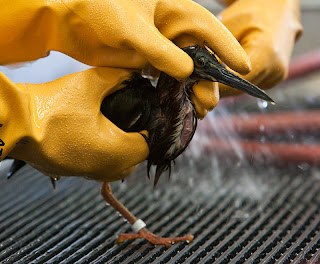
Daniel decides that he would spend three minutes of his time to save the bird, and that he would also be happy to pay at least $3 to have someone else spend a few minutes cleaning the bird. He introspects and finds that this is not just because he imagined a bird right in front of him: he feels that it is worth at least three minutes of his time (or $3) to save an oiled bird in some vague platonic sense.
And, because he's been thinking about scope insensitivity, he expects his brain to misreport how much he actually cares about large numbers of birds: the internal feeling of caring can't be expected to line up with the actual importance of the situation. So instead of just asking his gut how much he cares about de-oiling lots of birds, he shuts up and multiplies.
Thousands and thousands of birds were oiled by the BP spill alone. After shutting up and multiplying, Daniel realizes (with growing horror) that the amount he acutally cares about oiled birds is lower bounded by two months of hard work and/or fifty thousand dollars. And that's not even counting wildlife threatened by other oil spills.
And if he cares that much about de-oiling birds, then how much does he actually care about factory farming, nevermind hunger, or poverty, or sickness? How much does he actually care about wars that ravage nations? About neglected, deprived children? About the future of humanity? He actually cares about these things to the tune of much more money than he has, and much more time than he has.
For the first time, Daniel sees a glimpse of of how much he actually cares, and how poor a state the world is in.
This has the strange effect that Daniel's reasoning goes full-circle, and he realizes that he actually can't care about oiled birds to the tune of 3 minutes or $3: not because the birds aren't worth the time and money (and, in fact, he thinks that the economy produces things priced at $3 which are worth less than the bird's survival), but because he can't spend his time or money on saving the birds. The opportunity cost suddenly seems far too high: there is too much else to do! People are sick and starving and dying! The very future of our civilization is at stake!
Daniel doesn't wind up giving $50k to the WWF, and he also doesn't donate to ALSA or NBCF. But if you ask Daniel why he's not donating all his money, he won't look at you funny or think you're rude. He's left the place where you don't care far behind, and has realized that his mind was lying to him the whole time about the gravity of the real problems.
Now he realizes that he can't possibly do enough. After adjusting for his scope insensitivity (and the fact that his brain lies about the size of large numbers), even the "less important" causes like the WWF suddenly seem worthy of dedicating a life to. Wildlife destruction and ALS and breast cancer are suddenly all problems that he would move mountains to solve — except he's finally understood that there are just too many mountains, and ALS isn't the bottleneck, and AHHH HOW DID ALL THESE MOUNTAINS GET HERE?
In the original mindstate, the reason he didn't drop everything to work on ALS was because it just didn't seem… pressing enough. Or tractable enough. Or important enough. Kind of. These are sort of the reason, but the real reason is more that the concept of "dropping everything to address ALS" never even crossed his mind as a real possibility. The idea was too much of a break from the standard narrative. It wasn't his problem.
In the new mindstate, everything is his problem. The only reason he's not dropping everything to work on ALS is because there are far too many things to do first.
Alice and Bob and Christine usually aren't spending time solving all the world's problems because they forget to see them. If you remind them — put them in a social context where they remember how much they care (hopefully without guilt or pressure) — then they'll likely donate a little money.
By contrast, Daniel and others who have undergone the mental shift aren't spending time solving all the world's problems because there are just too many problems. (Daniel hopefully goes on to discover movements like effective altruism and starts contributing towards fixing the world's most pressing problems.)
5 =
I'm not trying to preach here about how to be a good person. You don't need to share my viewpoint to be a good person (obviously).
Rather, I'm trying to point at a shift in perspective. Many of us go through life understanding that we should care about people suffering far away from us, but failing to. I think that this attitude is tied, at least in part, to the fact that most of us implicitly trust our internal care-o-meters.
The "care feeling" isn't usually strong enough to compel us to frantically save everyone dying. So while we acknowledge that it would be virtuous to do more for the world, we think that we can't, because we weren't gifted with that virtuous extra-caring that prominent altruists must have.
But this is an error — prominent altruists aren't the people who have a larger care-o-meter, they're the people who have learned not to trust their care-o-meters.
Our care-o-meters are broken. They don't work on large numbers. Nobody has one capable of faithfully representing the scope of the world's problems. But the fact that you can't feel the caring doesn't mean that you can't do the caring.
You don't get to feel the appropriate amount of "care", in your body. Sorry — the world's problems are just too large, and your body is not built to respond appropriately to problems of this magnitude. But if you choose to do so, you can still act like the world's problems are as big as they are. You can stop trusting the internal feelings to guide your actions and switch over to manual control.
6 =
This, of course, leads us to the question of "what the hell do you then?"
And I don't really know yet. (Though I'll plug the Giving What We Can pledge, GiveWell, MIRI, and The Future of Humanity Institute as a good start).
I think that at least part of it comes from a certain sort of desperate perspective. It's not enough to think you should change the world — you also need the sort of desperation that comes from realizing that you would dedicate your entire life to solving the world's 100th biggest problem if you could, but you can't, because there are 99 bigger problems you have to address first.
I'm not trying to guilt you into giving more money away — becoming a philanthropist is really really hard. (If you're already a philanthropist, then you have my acclaim and my affection.) First it requires you to have money, which is uncommon, and then it requires you to throw that money at distant invisible problems, which is not an easy sell to a human brain. Akrasia is a formidable enemy. And most importantly, guilt doesn't seem like a good long-term motivator: if you want to join the ranks of people saving the world, I would rather you join them proudly. There are many trials and tribulations ahead, and we'd do better to face them with our heads held high.
7 =
Courage isn't about being fearless, it's about being able to do the right thing even if you're afraid.
And similarly, addressing the major problems of our time isn't about feeling a strong compulsion to do so. It's about doing it anyway, even when internal compulsion utterly fails to capture the scope of the problems we face.
It's easy to look at especially virtuous people — Gandhi, Mother Theresa, Nelson Mandela — and conclude that they must have cared more than we do. But I don't think that's the case.
Nobody gets to comprehend the scope of these problems. The closest we can get is doing the multiplication: finding something we care about, putting a number on it, and multiplying. And then trusting the numbers more than we trust our feelings.
Because our feelings lie to us.
When you do the multiplication, you realize that addressing global poverty and building a brighter future deserve more resources than currently exist. There is not enough money, time, or effort in the world to do what we need to do.
There is only you, and me, and everyone else who is trying anyway.
8 =
You can't actually feel the weight of the world. The human mind is not capable of that feat.
But sometimes, you can catch a glimpse.
这是一篇描述我成为有效利他主义者的部分动因的文章。它转载自我的博客。这里的许多想法与序列文章中的其他内容颇为相似。我有略微不同的视角,在校正了「典型心智谬误」之后,我预期这篇文章对许多人来说可能包含新的洞见。
1 =
我不太擅长感受大数字的大小。一旦数字超过1000(甚至可能超过100),这些数字就只是显得「很大」。
想想天狼星——夜空中最亮的星星。如果你告诉我天狼星有一百万个地球那么大,我会觉得那是很多个地球。反之,如果你告诉我你可以把十亿个地球塞进天狼星……我仍然只会觉得那是很多个地球。
这两种感受几乎完全一样。在前后文对照之下,我的大脑勉强承认十亿比一百万大得多,并象征性地努力去感受「十亿个地球大小的星星」比「一百万个地球大小的星星」更大。但脱离了对照——如果在听到「十亿」之前我没有被「一百万」锚定——这两个数字都只是模糊地显得很大。
如果你选择非常非常大的数字,我会感受到一点点对大数字的敬畏。如果你说「一后面跟着一百个零」,这感觉确实比十亿大得多。但它在我的直觉里,肯定不像是比十亿大10 000 000 000 000 000 000 000 000 000 000 000 000 000 000 000 000 000 000 000 000 000 000 000 000 000 000 000 000 000 000倍那样。不像四个苹果在直觉上感觉是两个苹果的两倍那样。我的大脑甚至无法开始理解这种量级差异。
这一现象与规模不敏感有关,它对我很重要,因为我生活在一个有时我所关心的事物数量极为庞大的世界里。
例如,数十亿人生活在贫困中,其中数亿人缺乏基本需求和/或死于疾病。尽管他们大多不在我的视线范围内,我仍然关心他们。
一个人的生命消逝,连同他所有的喜悦与悲伤,无论原因如何都是悲剧,这种悲剧并不因为我离得很远、或者我对此一无所知、或者我不知道如何帮助、或者这与我无关,而有所减少。
知道这一点,我关心这个星球上的每一个人。问题是,我的大脑根本无法把我对一个人的关怀程度扩大十亿倍。我缺乏那种内在容量去感受那么多。我的关怀计量表就是到不了那么高。
而这是个问题。
2 =
有个常见的说法:勇气不是无所畏惧,而是即使害怕也做正确的事。同理,关怀世界不是要有一种与世界苦难相对应的直觉感受,而是无论如何都要做正确的事。即使没有那种感受。
我内在的关怀计量表被校准为处理大约一百五十个人,它根本无法表达我对数十亿受苦者所拥有的关怀程度。内在的关怀计量表就是升不到那么高。
人类正在为难以想象的高赌注而博弈。至少,今天有数十亿人正在受苦。在最坏的情况下,未来可能存在数千万亿(甚至更多)的人类、跨人类或后人类,他们的存在取决于我们此时此地的所作所为。未来可能拥有的一切复杂文明,未来可能存在的体验、艺术与美,都取决于现在。
当你面对这样的赌注时,你内在的关怀启发式——被校准来处理「十」或「二十」这样的数字——完全无法理解这种情况的严重性。
拯救一个人的生命感觉很好,而拯救一个人的感觉与拯救整个世界的感觉可能差不多好。拯救世界肯定不会产生比拯救一个人多出数十亿倍的高峰感,因为你的硬件无法表达比拯救一个人的感觉大十亿倍的感觉。但即使拯救某人的利他高峰感与拯救世界的利他高峰感惊人地相似,请永远记住,在那些相似的感受背后,有着天壤之别。
我们内在的关怀感受,对于决定如何在一个有大问题的世界里行动来说,是严重不足的。
3 =
当我开始内化规模不敏感时,有一个心理转变发生在我身上。这有点难以表达,所以我要从几个故事开始。
想想 Alice,她是西雅图亚马逊的一名软件工程师。大约每个月,那些大学生会带着剪贴板出现在街角,越来越沮丧地努力说服人们向无国界医生捐款。通常,Alice 会避开眼神接触,继续自己的一天,但这个月他们终于把她堵住了。他们解释了无国界医生,她不得不承认这听起来确实是个很好的事业。在愧疚、社交压力和利他主义的共同作用下,她最终给了他们20美元,然后匆匆赶回去上班。(下个月,当他们再次出现时,她避开了眼神接触。)
再想想 Bob,他的脸书朋友给他发起了冰桶挑战。他觉得太忙了,没法做冰桶挑战,于是直接向美国肌萎缩性侧索硬化症协会捐了100美元。
再想想 Christine,她在大学女生联谊会 ΑΔΠ。ΑΔΠ 正在与另一个联谊会 ΠΒΦ 竞争,看谁能在一周内为国家乳腺癌基金会筹集更多资金。Christine 有竞争精神,投入到募捐中,在这周里自己捐了几百美元(尤其是在 ΑΔΠ 落后特别多的时候)。
这三个人都在向慈善机构捐款……这很好。但请注意这三个故事中有一个共同点:这些捐款在很大程度上是受社会情境驱动的。Alice 感受到义务和社交压力。Bob 感受到社交压力,也许还有一点友情。Christine 感受到友情和竞争心。这些都是很好的动机,但请注意,这些动机与社会环境相关,只是顺带与慈善捐款的内容有关联。
如果你问 Alice、Bob 或 Christine 中的任何一个人,为什么他们没有把所有的时间和金钱都捐给这些他们显然认为值得的事业,他们会用奇怪的眼神看你,并且可能觉得你很粗鲁(这有充分的理由!)。如果你追问,他们可能会告诉你钱现在有点紧张,或者如果他们是更好的人,他们会捐更多。
但这个问题仍然感觉有点奇怪。把所有钱都捐出去不是你用钱该做的事。我们都可以嘴上说把全部财产捐出去的人真的很伟大,但关起门来,我们都知道那些人是疯子。(也许是好的那种疯,但还是疯。)
这是我曾经处于其中的一种心态。有一种替代的心态,当你开始内化规模不敏感时,它会像货运列车一样撞上你。
4 =
想想 Daniel,一个在深水地平线BP 漏油事件之后不久的大学生。他在街角遇到了那些带着剪贴板的大学生,他们在为世界自然基金会募捐。他们试图拯救尽可能多的受油污的鸟。通常,Daniel 会直接以「不是最重要的事」、或「现在不值得花时间」、或「这是别人的问题」来打发掉这个慈善机构,但这次 Daniel 一直在思考他的大脑在数字方面有多差,于是决定做一个快速的理智检验。
他想象自己在漏油事件后沿着海滩行走,遇到一群人正在尽可能快地清洗鸟类。他们根本没有资源来清洗所有可用的鸟。一只可怜的小鸟扑腾着向他脚边挪来,满身油污,眼睛几乎睁不开。他蹲下来把它抱起,帮它放到台子上。一个清鸟者告诉他,他们自己没时间处理那只鸟了,但他可以戴上手套,大概只需要三分钟就能洗好那只鸟。
Daniel 决定他会花三分钟时间去救那只鸟,而且他也很乐意花至少3美元请别人花几分钟洗那只鸟。他自省后发现,这不仅仅是因为他想象中那只鸟就在他面前:他觉得在某种模糊的柏拉图意义上,拯救一只受油污的鸟值得至少三分钟的时间(或3美元)。
而且,因为他一直在思考规模不敏感,他预料到他的大脑会错误地汇报他对大量的鸟实际上关心多少:内在的关怀感受不能被期待与实际情况的重要性相一致。所以,他没有只是问直觉他有多关心给大量的鸟除油,而是闭嘴,做了乘法。
在 BP 漏油事件中,数以千计的鸟受到油污。在闭嘴做完乘法之后,Daniel(带着越来越大的恐惧)意识到,他对受油污的鸟的实际关心程度,下限是两个月的辛苦工作和/或五万美元。这还没算上其他漏油事件所威胁的野生动物。
如果他对给鸟除油的关心程度就这么多,那么他对工厂化养殖究竟关心多少,更别提饥饿、贫困、疾病了?他对蹂躏国家的战争究竟关心多少?对被忽视、被剥夺的儿童?对人类的未来?他实际上对这些事情的关心程度,以远超他拥有的金钱来衡量,以远超他拥有的时间来衡量。
第一次,Daniel 瞥见了他实际上关心多少,以及世界处于多么糟糕的状态。
这产生了一个奇特的效果,Daniel 的推理绕了一圈,他意识到他实际上不能以3分钟或3美元的程度去关心受油污的鸟:不是因为那些鸟不值那时间和金钱(事实上,他认为经济体产出的价格3美元的东西,其价值低于那只鸟的存活),而是因为他不能把他的时间或金钱花在救鸟上。机会成本突然显得高得太多了:还有太多其他事情要做! 人们正在生病、挨饿、死去!我们文明的未来岌岌可危!
Daniel 最终没有给世界自然基金会捐5万美元,他也没有给美国肌萎缩性侧索硬化症协会或国家乳腺癌基金会捐款。但如果你问Daniel为什么他没有把所有钱都捐出去,他不会用奇怪的眼神看你,也不会觉得你粗鲁。他已经离那个不在乎的地方很远了,并意识到他的思维一直在对他撒谎,骗他说那些真实问题没那么严重。
现在他意识到他根本不可能做得够多。在校正了他的规模不敏感(以及他的大脑在大数字上撒谎的事实)之后,即使是像世界自然基金会这样「不那么重要」的事业,突然间也显得值得为之奉献一生。野生动物破坏、肌萎缩性侧索硬化症和乳腺癌,突然都成了他会移山填海去解决的问题——除了他终于明白山太多了,而肌萎缩性侧索硬化症并不是瓶颈,而且啊啊啊这些山怎么都在这里?
在原来的心态中,他没有放弃一切去解决肌萎缩性侧索硬化症,是因为它看起来就是……不够迫切。或者不够可解决。或者不够重要。有点儿。这些算是理由,但真正的原因更在于「放弃一切去解决肌萎缩性侧索硬化症」这个概念,从未进入他的脑海成为一个真实的可能性。这个想法太像是对标准叙事的突破了。这不是他的问题。
在新的心态中,一切都是他的问题。他没有放弃一切去解决肌萎缩性侧索硬化症的唯一原因,是因为还有太多事情要先做。
Alice、Bob 和 Christine 通常不花时间解决世界上所有的问题,是因为他们忘了看见这些问题。如果你提醒他们——把他们置于一个社会情境中,让他们记起自己有多在乎(希望不是通过愧疚或压力)——他们很可能会捐一点钱。
相比之下,Daniel 和其他经历了这种心理转变的人,不花时间解决世界上所有的问题,是因为问题实在太多了。(Daniel 之后有望发现有效利他主义这样的运动,并开始为解决世界上最紧迫的问题做出贡献。)
5 =
我不是在这里说教如何做一个好人。你不需要认同我的观点才能成为一个好人(显然如此)。
相反,我试图指向一种视角的转变。我们许多人都理解我们应该关心远离我们的受苦之人,却没能做到。我认为这种态度至少在一定程度上与以下事实有关:我们大多数人都隐性地信任自己内在的关怀计量表。
「关怀感受」通常不够强烈,不足以迫使我们疯狂地去拯救所有正在死去的人。所以,虽然我们承认为世界做更多事情会是有美德的,但我们认为我们做不到,因为我们没有被赋予那种让杰出利他主义者拥有的、有美德的额外关怀。
但这是一个错误——杰出的利他主义者不是拥有更大关怀计量表的人,他们是学会了不信任自己的关怀计量表的人。
我们的关怀计量表坏了。它们在大数字上不起作用。没有人拥有一个能忠实地表征世界问题规模的关怀计量表。但你感受不到那种关怀,并不意味着你做不到那种关怀。
你无法在身体上感受到适当程度的「关怀」。抱歉——世界的问题实在太大了,而你的身体并非为了对这种规模的问题做出恰当反应而构建的。但如果你选择这样做,你仍然可以行动得像世界的问题有其实际的大小一样。你可以停止信任内在感受来指导你的行动,切换到手动控制。
6 =
这当然引出了「那你他妈然后怎么办?」这个问题。
我还真不太知道。(不过我要推荐承诺给予、GiveWell、MIRI和人类未来研究所作为一个好的起点。)
我认为这至少部分来自一种特定的绝望视角。仅仅认为你应该改变世界是不够的——你还需要那种来自这样一种认识的绝望:你愿意把整个人生都奉献给解决世界上第100大的问题,如果你能的话,但你不能,因为还有99个更大的问题你必须先解决。
我不是试图用愧疚来逼你捐更多钱——成为一个慈善家真的非常非常难。(如果你已经是一个慈善家,那你获得了我的钦佩和我的喜爱。)首先它要求你有钱,这并不常见,然后它要求你把那些钱扔向遥远的、看不见的问题,这对人类大脑来说不是件容易卖出的事。意志力薄弱是一个强大的敌人。最重要的是,愧疚看起来不像是一个好的长期激励因素:如果你想加入拯救世界的人们的行列,我宁愿你自豪地加入他们。前方有许多考验与磨难,我们最好昂首阔步地面对它们。
7 =
勇气不是无所畏惧,而是即使害怕也能做正确的事。
同样,解决我们时代的重大问题,不是关于感受到强烈的冲动去这样做。而是无论如何都去做,即使内在的冲动完全无法捕捉到我们所面临问题的规模。
很容易看着特别有美德的人——甘地、特蕾莎修女、纳尔逊·曼德拉——并得出结论说他们一定比我们更在乎。但我不认为是这样的。
没有人能理解这些问题的规模。我们能做到的最接近的,是做乘法:找到我们关心的事情,给它赋一个数字,然后相乘。然后信任那些数字多于信任我们的感受。
因为我们的感受在欺骗我们。
当你做了乘法,你会意识到解决全球贫困和构建更光明的未来,所应得的资源超过目前存在的一切。世界上没有足够的金钱、时间或努力来完成我们需要做的事情。
只有你,和我,以及所有其他仍在尝试的人。
8 =
你实际上感受不到世界的重量。人类的心智没有这种能力。
但有时,你能瞥见一丝。