Concise Summary简洁概述
Scott Alexander opens with Sandy, a morbidly obese woman whose husband blames willpower, whose doctor blames genetics, and whose sister blames society. The real fight, Alexander argues, is about the word "disease": we use it as a hidden lever to decide who gets sympathy and who gets medical treatment. Drawing on Eliezer Yudkowsky's cluster-concept analysis, he shows that "disease" satisfies some criteria (biological cause, unpleasantness) but not others (rarity, discreteness) for conditions like obesity, so asking whether they "really are" diseases is as meaningless as asking whether Pluto is really a planet. Instead, adopting a determinist-consequentialist view, we should extend sympathy and condemnation based on whether blame actually helps, and allow medical treatment whenever it is safe and effective — independent of the disease label.
Scott Alexander 以 Sandy 的故事开场:这位重度肥胖女性面对三种截然不同的声音——丈夫怪她意志力不足,医生归因于基因,姐妹则归咎于社会。Alexander 指出,真正的争论核心是「疾病」这个词:我们用它作为隐藏的杠杆,决定谁值得同情、谁有资格接受医疗干预。借助 Yudkowsky 对聚类概念的分析,他说明对于肥胖这类边缘状况,「疾病」的某些标准(生物成因、令人痛苦)能满足,另一些(罕见性、离散性)却不能,因此争论它们「到底算不算」疾病,就像争论冥王星是否真的是行星一样毫无意义。他主张采取决定论-后果主义立场:仅当谴责确实能减少问题时才加以谴责;只要治疗安全有效,便应允许患者寻求治疗,无须理会「疾病」标签。
Infographic信息图
Disease as a cluster concept
疾病是聚类概念
Like Yudkowsky's blegg/rube, "disease" picks out a cluster of correlated features; marginal conditions satisfy some but not all, making the category boundary arbitrary.
如同 Yudkowsky 的 blegg/rube,「疾病」指向一组相关特征的聚类;边缘状况满足其中一些而非全部,使分类边界变得任意。
Hidden inferences from a label
标签背后的隐藏推断
The disease node is used to trigger downstream value decisions — sympathy vs. condemnation, and legitimate vs. shameful medical treatment — even though the label itself should be a "hanging node."
「疾病」节点被用来触发下游价值判断——同情还是谴责、合法还是可耻的医疗行为——尽管这个标签本身应当是个「悬挂节点」。
Consequentialist blame
后果主义的责任观
Alexander's rule: condemn if condemnation reduces the condition more than it harms the person; otherwise, sympathize. This replaces the impossible question of "spiritual vs. biological" causation.
Alexander 的规则:若谴责对减少该状况的效果超过其对当事人的伤害,则谴责;否则,给予同情。这取代了「精神原因还是生物原因」这一无解问题。
Medical treatment is not cheating
医疗干预不是「作弊」
Katja Grace's signaling argument explains resistance: people who sacrificed to overcome a condition see an easy pill as an attack on their virtue, not just a practical alternative.
Katja Grace 的信号论解释了抵制的原因:那些为克服某种状况付出了牺牲的人,将唾手可得的药丸视为对自身美德的攻击,而非一种实用替代。
Social vs. biological susceptibility
对社会干预的敏感程度
Determinists can still distinguish: some biology (laziness) responds to social pressure; other biology (cancer) does not — so blame and sympathy track usefulness, not metaphysical purity.
决定论者仍能做出区分:某些生物状态(懒惰)对社会压力有反应,另一些(癌症)则完全免疫——因此,谴责与同情的分配取决于实用性,而非形而上学的纯粹性。
Detailed Summary详细概述
The Setup: Three Voices, One Condition
Alexander opens with Sandy, a morbidly obese woman caught between three irreconcilable advisers. Her husband says she needs willpower. Her doctor says it is genetic and recommends orlistat or gastric bypass. Her sister says fatness is a valid lifestyle and fat-ism is just another form of discrimination. When each hears the others' views, accusations fly: the doctor and sister are enabling irresponsibility; the husband is medically ignorant and cruel; the doctor is medicalizing behavior to profit Big Pharma; the sister is legitimizing a health risk.
Sandy is fictional, but the dynamic is real and recurs across dozens of conditions — ADHD, internet addiction, social anxiety disorder, alcoholism, chronic fatigue, oppositional defiant disorder, compulsive gambling, depression — each claimed by different camps as a character flaw, a disease, or normal variation.
What "Disease" Actually Is
Applying Yudkowsky's cluster-concept analysis (from Disguised Queries), Alexander notes that "disease" is a word useful because the features it names tend to co-occur:
- Biological causation (proteins, bacteria, genes)
- Involuntary / immune to free will
- Rare in the general population
- Unpleasant — you want to be rid of it
- Discrete — bimodal population, not a normal distribution
- Treatable with science-based interventions
Cancer satisfies all six. Dwarfism fails criterion 5. Aging fails criterion 3. Homosexuality famously fails criterion 4. Obesity partly satisfies 1, 4, 6 but struggles with 2, 3, and 5.
So is obesity a disease? Alexander's answer: Is Pluto a planet? Once you know which criteria are met and which aren't, the extra question "does it really deserve the label?" adds nothing. It is the same dissolved-question move familiar from the Sequences.
The Hidden Inferences
The label would be harmless if it were truly a "hanging node." But it is not. Whether something is called a disease determines:
- Sympathy or condemnation. Cancer patients are "brave"; those with non-disease conditions get called pigs, told to man up, or labelled weird. Shyness vs. social anxiety disorder is exactly this gap.
- Permission to seek treatment. Alexander reports doctors uncomfortable prescribing gastric bypass — medically indicated — because they consider obesity a character issue, not a disease.
Dissolving the Questions
On sympathy/blame, Alexander argues that the deontological libertarian model ("free will caused the bad act, therefore deserving punishment") is both philosophically unsound and practically unworkable for marginal conditions. Determinist consequentialists have a better rule: condemn when condemnation is the most effective intervention; sympathize otherwise. Yelling at a cancer patient does nothing; social pressure on laziness may work, because laziness, unlike cancer, is a biological phenomenon susceptible to social input.
The question for obesity then becomes: does condemning obese people reduce obesity enough to be worth the harm it causes? This is an empirical question — potentially with different answers for different people and contexts.
On treatment, Alexander rebuts three objections:
- Biological solutions to spiritual problems are dehumanizing. Only if you believe in spiritual vs. biological distinctions, which determinists do not.
- Easy fixes prevent learning personal responsibility. Alexander applies Bostrom's preference-reversal test: if personal responsibility is really the priority, you'd want to addict schoolchildren to heroin so they can kick it the old-fashioned way. No one accepts that — so revealed preference shows that being off heroin is more important than the route taken.
- Resistance to medical solutions is really virtue-signaling. He quotes Katja Grace: people who sacrificed to overcome a condition see an easy pill as an attack on their demonstrated virtue, not merely an alternative route to the same outcome.
Summary and Conclusion
Alexander closes by calling the "is it a disease?" debate a disguised proxy fight for two real questions: who gets sympathy, and who gets treatment. Determinist consequentialism answers both: blame where it helps; allow treatment wherever it works, regardless of the disease label.
开场设定:同一状况,三种声音
Alexander 以 Sandy 的故事切入。Sandy 是一位重度肥胖女性,面对三种彼此矛盾的建议。丈夫说她需要意志力。医生说肥胖主要是基因所致,建议她服用奥利司他或考虑胃旁路手术。姐妹说肥胖是完全合理的生活方式,「胖歧视」不过是社会压迫的另一种形式。当三人得知彼此的观点,指责随即四起:医生和姐妹在替她的失责开脱;丈夫既无医学常识又冷酷无情;医生在将行为医疗化以便让大药厂赚钱;姐妹在为健康风险背书。
Sandy 是虚构的,但这种争论在现实中屡见不鲜,且贯穿数十种状况——ADHD、网络成瘾、社交焦虑障碍、酗酒、慢性疲劳、对立违抗障碍、强迫性赌博、抑郁症——每一种都被不同阵营分别归类为性格缺陷、疾病,或人类状态的正常变体。
「疾病」到底是什么
借助 Yudkowsky 在《伪装的询问》中对聚类概念的分析,Alexander 指出,「疾病」这个词之所以有用,是因为它所命名的那些特征往往共同出现:
- 生物学成因(蛋白质、细菌、基因)
- 非自愿性/完全不受意志力左右
- 罕见性,普通人群中极少发生
- 令人痛苦,患者希望摆脱它
- 离散性,人群分布呈双峰而非正态
- 可用科学干预手段治疗
癌症满足全部六条标准。侏儒症不符合第5条。衰老不符合第3条。同性恋显然不符合第4条。肥胖部分满足第1、4、6条,但在第2、3、5条上难以自圆其说。
那么,肥胖到底算不算疾病?Alexander 的回答是:冥王星到底是不是行星? 一旦你知道哪些标准被满足、哪些未被满足,「它到底配不配这个标签」这个额外问题就什么都不能增加。这与《序列》文章中那个「消解问题」的动作如出一辙。
隐藏的推断
如果「疾病」标签真的是个「悬挂节点」,它本来无关紧要。但它并非如此。某事被称为疾病与否,决定了两件事:
- 同情还是谴责。 癌症患者被称为「勇敢的斗士」;被认定为非疾病状况的人,则被叫做「懒猪」、被叫去「振作起来」或被视为怪人。「害羞」与「社交焦虑障碍」之间的区别,正是这道鸿沟。
- 是否有权寻求治疗。 Alexander 提到,有医生在为医学上已有明确指征的胃旁路手术开具处方时感到不安——因为他们认为肥胖是性格问题,而非疾病。
消解这两个问题
关于同情与谴责,Alexander 认为,义务论自由意志模型(「自由意志促成了恶行,因此理应受罚」)在哲学上站不住脚,且对边缘状况无从操作。决定论-后果主义者有更好的规则:当谴责是最有效的干预手段时,才加以谴责;否则,给予同情。 对癌症患者大喊大叫毫无作用;对懒惰施以社会压力或许奏效,因为懒惰——与癌症不同——是一种对社会影响有响应的生物现象。
对肥胖而言,问题由此转变为:谴责肥胖者,对减少肥胖的效果,是否足以抵消它对当事人造成的伤害? 这是一个实证问题——对不同的人和不同的情境,答案可能各异。
关于治疗,Alexander 逐一反驳了三种反对意见:
- 用生物手段解决精神问题是对人的贬低。 只有当你相信精神原因与生物原因之间存在区别时,这才成立——决定论者不接受这一前提。
- 简单的解决方案会妨碍人们学习个人责任感。 Alexander 援引 Bostrom 的「偏好反转测试」:如果个人责任感真的比不上瘾更重要,那你就应该支持故意让小学生对海洛因上瘾,以便让他们用老办法戒掉。没有人接受这个令人震惊的结论——这说明在内心深处,人们认为「不再上瘾」比「靠意志力戒掉」更重要。
- 对医疗解决方案的抵制,本质上是美德信号。 他引用了 Katja Grace 的观点:那些曾经为克服某种状况付出牺牲的人,将一颗唾手可得的药丸视为对自身已展示之美德的攻击,而非通往同一终点的另一条路。
总结与结论
Alexander 最后指出,「它算不算疾病」的争论,不过是两个真实问题的伪装代理战:谁该获得同情,谁有权接受治疗。决定论-后果主义对两者都给出了回答:当谴责有助于改变状况时,才予以谴责;无论是否冠以「疾病」标签,只要治疗有效,就应允许患者寻求治疗。
FAQ常见问答
What is the "cluster concept" argument, and why does it dissolve the disease debate?「聚类概念」论证是什么,它为何能消解关于疾病的争论?
Yudkowsky showed that useful words pick out clusters of co-occurring properties. "Disease" names a cluster (biological cause, involuntariness, rarity, unpleasantness, discreteness, medical treatability). Marginal conditions like obesity satisfy some criteria but not all. Once you map which criteria are met, there is no further fact to discover about whether the thing "really is" a disease — the additional question is empty, just as asking whether Pluto is "really" a planet was empty after its orbital properties were known.
Yudkowsky 指出,有用的词汇所指向的是一组共同出现的属性聚类。「疾病」所命名的聚类包括:生物学成因、非自愿性、罕见性、令人痛苦、离散分布、可医疗干预。肥胖之类的边缘状况满足其中一些而非全部。一旦你把哪些标准被满足都梳理清楚,「这东西到底算不算疾病」这个追加问题就什么内容都没有了——正如在冥王星的轨道属性已知之后,「它到底是不是行星」同样是个空洞的问题。
What is the "hidden inference" problem with the disease label?「疾病」标签的「隐藏推断」问题是什么?
The label should, in principle, be a neutral classification node. In practice, it acts as a switch for two downstream decisions: whether the person gets sympathy or condemnation, and whether seeking medical treatment is seen as legitimate or as an abdication of personal responsibility. Because it carries these social stakes, people fight over it as if it were an important factual question — but the real questions (sympathy? treatment?) can and should be addressed directly.
这个标签原则上应该是一个中立的分类节点。但在实际中,它起着开关的作用,触发两个下游决定:此人是否应该获得同情或谴责,以及寻求医疗干预是否被视为合理还是逃避个人责任。正因为标签承载了这些社会赌注,人们才像争论一个重要事实问题一样争论它——但真正的问题(同情?治疗?)完全可以、也应该被直接回答。
How does the determinist consequentialist view change the sympathy/blame question?决定论-后果主义观点如何改变同情/责任问题?
Under the libertarian deontological view, blame tracks metaphysical desert: bad choices made with free will make you a bad person deserving bad treatment. Determinists reject free will as a meaningful category — everything is biological all the way down. So blame is never deserved in a cosmic sense, but it can still be useful: social condemnation is an intervention that sometimes changes behavior. The rule becomes empirical — condemn when condemnation reduces the condition more than it hurts — rather than metaphysical.
在义务论自由意志观中,责任追踪的是形而上学意义上的「应得」:用自由意志做出了错误选择,就成为理应受到坏对待的坏人。决定论者拒绝将自由意志视为有意义的范畴——一切从根本上都是生物学的。因此,责任在宇宙意义上从不「应得」,但它仍可能是有用的:社会谴责是一种有时能改变行为的干预手段。于是,规则变成了实证性的——当谴责对减少状况的效果超过其对当事人的伤害时,才加以谴责——而非形而上学性的。
What is the Katja Grace signaling argument, and why does Alexander find it convincing?Katja Grace 的信号论证是什么,Alexander 为何认为它有说服力?
Grace observed a recurring pattern: people who make personal sacrifices for a cause (eating less, exercising, quitting alcohol through willpower) come to see their sacrifice as virtuous in itself. When an easier solution emerges, they resist it — not primarily because it's less effective, but because adopting it would delegitimize the moral status they earned through suffering. Alexander finds this explains much of the visceral resistance to medical solutions for "character flaws": it is not really about the patient's welfare, but about the moral economy of those who sacrificed.
Grace 观察到一种反复出现的模式:为某一事业做出个人牺牲的人(少吃、锻炼、靠意志力戒酒),逐渐开始将自己的牺牲本身视为美德。当更简便的解决方案出现时,他们予以抵制——并非主要因为它效果更差,而是因为接受它会让自己通过受苦赢得的道德地位失去合法性。Alexander 认为,这解释了对「性格缺陷」医疗解决方案的发自内心的抵制:这其实与患者的福祉无关,而是关于那些曾经付出牺牲的人的道德经济学。
Does Alexander argue that medical treatment is always better than willpower-based approaches?Alexander 是否主张医疗干预总是优于依靠意志力的做法?
No. He argues that the objections to medical treatment do not automatically become stronger just because the condition is traditionally regarded as a character flaw rather than a disease. The standard concerns — side effects, cost, dependence, placebo risk, consent in vulnerable populations — apply equally to cancer drugs and addiction drugs. He concludes: if treatment is available and effective, people should not be denied it or stigmatized for seeking it, regardless of the disease label.
不是。他的论点是:反对医疗干预的那些理由,不会仅仅因为这种状况传统上被视为性格缺陷而非疾病,就自动变得更有力。标准的担忧——副作用、费用、依赖性、安慰剂风险、对弱势群体的知情同意——同样适用于癌症药物和成瘾药物。他的结论是:如果某种治疗方法可用且有效,就不应拒绝人们获得它,也不应因寻求治疗而受到污名化,无论是否冠以「疾病」标签。
What is the preference-reversal test Alexander borrows from Bostrom, and how does it work here?Alexander 借用 Bostrom 的「偏好反转测试」是什么,它在这里如何运作?
Bostrom's test: if someone genuinely believes X is more important than Y, they should be willing to accept a policy that sacrifices Y to gain X, even when that policy is presented in a morally uncomfortable way. Alexander applies it to the claim that "learning personal responsibility" is more important than being cured of addiction: if true, you'd support deliberately addicting children to heroin so they can develop responsibility by quitting. Since almost no one accepts that, the revealed preference is that being drug-free matters more than the route taken to get there.
Bostrom 的测试是:如果某人真心认为 X 比 Y 更重要,他就应该愿意接受一种以牺牲 Y 来获得 X 的政策,即便这种政策以道德上令人不舒服的方式呈现出来。Alexander 将其用于「学习个人责任感比从成瘾中康复更重要」这一主张:如果属实,你就应该支持故意让孩子对海洛因上瘾,以便让他们通过戒断来培养责任感。由于几乎没有人接受这一点,被揭示的真实偏好是:不再上瘾比通过什么途径做到更重要。
In-depth Analysis · Pros & Cons深入解读 · 优缺点
Written by Scott Alexander (then blogging as Yvain) and posted to LessWrong, this essay applies the cluster-concept and dissolving-the-question toolkit — developed by Yudkowsky in the Sequences — to a concrete socio-medical dispute. It is one of the clearest demonstrations of how verbal disputes about categories can generate real-world harm when the category label carries hidden value decisions.
本文由 Scott Alexander(当时以 Yvain 为笔名)撰写并发布于 LessWrong,将 Yudkowsky 在「序列」中开发的聚类概念分析与「消解问题」工具包,应用于一场具体的社会医学争论。这是最清晰地展示「语词之争如何因标签承载隐藏的价值判断而造成现实伤害」的论文之一。
- Concrete case that stays grounded案例具体且始终落地Sandy's story and the obesity example thread through the entire essay. Unlike purely abstract philosophy, this keeps the argument testable against intuition at each step.Sandy 的故事和肥胖的例子贯穿全文。与纯粹抽象的哲学不同,这使得论证在每一步都可以与直觉进行检验。
- Clean separation of two distinct questions清晰分离两个不同问题Alexander identifies that the "disease" fight is really two fights (sympathy/blame and treatment access) and gives a different analysis for each. This decomposition is the essay's main intellectual contribution.Alexander 指出「疾病」之争实际上是两场争论(同情/谴责与治疗权限),并对每场给出不同分析。这种分解是本文最主要的智识贡献。
- Preference-reversal test is rhetorically powerful偏好反转测试在修辞上很有力The heroin-addiction-for-responsibility thought experiment is uncomfortable on purpose — it forces readers to admit that outcome, not process, is what they actually care about, undercutting the "personal responsibility" objection to treatment.「为培养责任感而故意让孩子上瘾」这个思想实验令人不安是有意为之的——它迫使读者承认,他们真正在乎的是结果而非过程,从而拆解了反对治疗的「个人责任」论点。
- Katja Grace attribution is honest如实归功于 Katja GraceThe virtue-signaling explanation of medical resistance is one of the most useful parts of the essay, and Alexander credits it to Grace rather than claiming it himself — a model of intellectual honesty.对医疗抵制的美德信号解释是本文最有价值的部分之一,Alexander 将其归功于 Grace 而非据为己有——树立了智识诚实的榜样。
- The consequentialist rule is underspecified后果主义规则未充分细化"Condemn when condemnation reduces the condition more than it hurts" sounds empirical, but Alexander provides no method for actually measuring these competing effects in practice. The rule dissolves the philosophical impasse but leaves the empirical question entirely open.「当谴责对减少状况的效果超过其对当事人的伤害时才予以谴责」听起来是实证性的,但 Alexander 没有提供在实践中实际衡量这两种相互竞争效果的方法。该规则消解了哲学僵局,但将实证问题完全搁置在一旁。
- Determinism is assumed, not argued决定论是被假定的,而非被论证的The entire "biology all the way down" move does heavy lifting here. Alexander dismisses libertarian free will briefly, but the case for hard determinism — and its compatibility with holding people responsible at all — is one of the most contested questions in philosophy. Readers who aren't already persuaded will not be converted.「一切从根本上都是生物学」这一动作在这里承担了繁重的工作。Alexander 对自由意志论的驳斥相当简短,但硬决定论的论证——以及它与追究责任的相容性——是哲学中争议最大的问题之一。未被预先说服的读者不会因此而被转化。
- The obesity empirics are dated and contested肥胖的实证依据已过时且存在争议Alexander asserts that obesity "arguably" satisfies biological-cause and medical-treatability criteria but not voluntariness, rarity, or discreteness. By 2010 standards this was reasonable; since then, the genetics of obesity (polygenic risk scores) and its public health epidemiology have both become far better understood in ways that complicate the picture he draws.Alexander 断言肥胖「可以说」满足生物学成因和可医疗干预的标准,但不满足非自愿性、罕见性或离散性。以2010年的标准来看这是合理的;但此后,肥胖的遗传学(多基因风险评分)和公共卫生流行病学都得到了更深入的理解,使他所描绘的图景更为复杂。
- Signaling argument proves too much信号论证证明了过多Grace's "sacrifice becomes virtuous" pattern is real, but if taken as the primary explanation for all resistance to medical treatment, it pathologizes caution that sometimes has legitimate grounds — drug side effects, pharmaceutical marketing fraud, the history of psychiatric over-medication. Applying it too broadly risks dismissing valid concerns as mere status-protection.Grace 的「牺牲本身变得高尚」模式确实存在,但若将其作为所有对医疗干预之抵制的主要解释,它就会将有时具有正当理由的谨慎病理化——药物副作用、制药营销欺诈、精神科过度用药的历史。过于宽泛地运用它,可能将合理的担忧错误地定性为单纯的地位保护。
A well-executed application of LW conceptual tools to a messy real-world dispute. Its core move — replace the empty category fight with two tractable empirical questions — is genuinely useful and widely applicable. The essay is weaker as philosophical argument (determinism needs more defense, the consequentialist rule needs operationalization) but stronger as a practical heuristic for cutting through moralizing noise.
这是将 LW 概念工具应用于一场混乱现实争论的出色尝试。其核心动作——用两个可处理的实证问题取代空洞的分类之争——真正有用且广泛适用。作为哲学论证,本文较弱(决定论需要更充分的辩护,后果主义规则需要可操作化);但作为穿透道德噪音的实践启发,它更为有力。
Original Text原文
Related to: Disguised Queries, Words as Hidden Inferences, Dissolving the Question, Eight Short Studies on Excuses
Today's therapeutic ethos, which celebrates curing and disparages judging, expresses the liberal disposition to assume that crime and other problematic behaviors reflect social or biological causation. While this absolves the individual of responsibility, it also strips the individual of personhood, and moral dignity
\-\- George Will, townhall.com
Sandy is a morbidly obese woman looking for advice.
Her husband has no sympathy for her, and tells her she obviously needs to stop eating like a pig, and would it kill her to go to the gym once in a while?
Her doctor tells her that obesity is primarily genetic, and recommends the diet pill orlistat and a consultation with a surgeon about gastric bypass.
Her sister tells her that obesity is a perfectly valid lifestyle choice, and that fat-ism, equivalent to racism, is society's way of keeping her down.
When she tells each of her friends about the opinions of the others, things really start to heat up.
Her husband accuses her doctor and sister of absolving her of personal responsibility with feel-good platitudes that in the end will only prevent her from getting the willpower she needs to start a real diet.
Her doctor accuses her husband of ignorance of the real causes of obesity and of the most effective treatments, and accuses her sister of legitimizing a dangerous health risk that could end with Sandy in hospital or even dead.
Her sister accuses her husband of being a jerk, and her doctor of trying to medicalize her behavior in order to turn it into a "condition" that will keep her on pills for life and make lots of money for Big Pharma.
Sandy is fictional, but similar conversations happen every day, not only about obesity but about a host of other marginal conditions that some consider character flaws, others diseases, and still others normal variation in the human condition. Attention deficit disorder, internet addiction, social anxiety disorder (as one skeptic said, didn't we used to call this "shyness"?), alcoholism, chronic fatigue, oppositional defiant disorder ("didn't we used to call this being a teenager?"), compulsive gambling, homosexuality, Aspergers' syndrome, antisocial personality, even depression have all been placed in two or more of these categories by different people.
Sandy's sister may have a point, but this post will concentrate on the debate between her husband and her doctor, with the understanding that the same techniques will apply to evaluating her sister's opinion. The disagreement between Sandy's husband and doctor centers around the idea of "disease". If obesity, depression, alcoholism, and the like are diseases, most people default to the doctor's point of view; if they are not diseases, they tend to agree with the husband.
The debate over such marginal conditions is in many ways a debate over whether or not they are "real" diseases. The usual surface level arguments trotted out in favor of or against the proposition are generally inconclusive, but this post will apply a host of techniques previously discussed on Less Wrong to illuminate the issue.
What is Disease?
In Disguised Queries , Eliezer demonstrates how a word refers to a cluster of objects related upon multiple axes. For example, in a company that sorts red smooth translucent cubes full of vanadium from blue furry opaque eggs full of palladium, you might invent the word "rube" to designate the red cubes, and another "blegg", to designate the blue eggs. Both words are useful because they "carve reality at the joints" - they refer to two completely separate classes of things which it's practically useful to keep in separate categories. Calling something a "blegg" is a quick and easy way to describe its color, shape, opacity, texture, and chemical composition. It may be that the odd blegg might be purple rather than blue, but in general the characteristics of a blegg remain sufficiently correlated that "blegg" is a useful word. If they weren't so correlated - if blue objects were equally likely to be palladium-containing-cubes as vanadium-containing-eggs, then the word "blegg" would be a waste of breath; the characteristics of the object would remain just as mysterious to your partner after you said "blegg" as they were before.
"Disease", like "blegg", suggests that certain characteristics always come together. A rough sketch of some of the characteristics we expect in a disease might include:
1\. Something caused by the sorts of thing you study in biology: proteins, bacteria, ions, viruses, genes.
2\. Something involuntary and completely immune to the operations of free will
3\. Something rare; the vast majority of people don't have it
4\. Something unpleasant; when you have it, you want to get rid of it
5\. Something discrete; a graph would show two widely separate populations, one with the disease and one without, and not a normal distribution.
6\. Something commonly treated with science-y interventions like chemicals and radiation.
Cancer satisfies every one of these criteria, and so we have no qualms whatsoever about classifying it as a disease. It's a type specimen, the sparrow as opposed to the ostrich. The same is true of heart attack, the flu, diabetes, and many more.
Some conditions satisfy a few of the criteria, but not others. Dwarfism seems to fail (5), and it might get its status as a disease only after studies show that the supposed dwarf falls way out of normal human height variation. Despite the best efforts of transhumanists, it's hard to convince people that aging is a disease, partly because it fails (3). Calling homosexuality a disease is a poor choice for many reasons, but one of them is certainly (4): it's not necessarily unpleasant.
The marginal conditions mentioned above are also in this category. Obesity arguably sort-of-satisfies criteria (1), (4), and (6), but it would be pretty hard to make a case for (2), (3), and (5).
So, is obesity really a disease? Well, is Pluto really a planet? Once we state that obesity satisfies some of the criteria but not others, it is meaningless to talk about an additional fact of whether it "really deserves to be a disease" or not.
If it weren't for those pesky hidden inferences...
Hidden Inferences From Disease Concept
The state of the disease node, meaningless in itself, is used to predict several other nodes with non-empirical content. In English: we make value decisions based on whether we call something a "disease" or not.
If something is a real disease, the patient deserves our sympathy and support; for example, cancer sufferers must universally be described as "brave". If it is not a real disease, people are more likely to get our condemnation; for example Sandy's husband who calls her a "pig" for her inability to control her eating habits. The difference between "shyness" and "social anxiety disorder" is that people with the first get called "weird" and told to man up, and people with the second get special privileges and the sympathy of those around them.
And if something is a real disease, it is socially acceptable (maybe even mandated) to seek medical treatment for it. If it's not a disease, medical treatment gets derided as a "quick fix" or an "abdication of personal responsibility". I have talked to several doctors who are uncomfortable suggesting gastric bypass surgery, even in people for whom it is medically indicated, because they believe it is morally wrong to turn to medicine to solve a character issue.
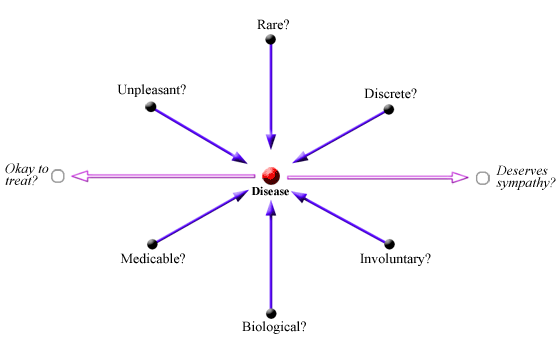
While a condition's status as a "real disease" ought to be meaningless as a "hanging node" after the status of all other nodes have been determined, it has acquired political and philosophical implications because of its role in determining whether patients receive sympathy and whether they are permitted to seek medical treatment.
If we can determine whether a person should get sympathy, and whether they should be allowed to seek medical treatment, independently of the central node "disease" or of the criteria that feed into it, we will have successfully unasked the question "are these marginal conditions real diseases" and cleared up the confusion.
Sympathy or Condemnation?
Our attitudes toward people with marginal conditions mainly reflect a deontologist libertarian (libertarian as in "free will", not as in "against government") model of blame. In this concept, people make decisions using their free will, a spiritual entity operating free from biology or circumstance. People who make good decisions are intrinsically good people and deserve good treatment; people who make bad decisions are intrinsically bad people and deserve bad treatment. But people who make bad decisions for reasons that are outside of their free will may not be intrinsically bad people, and may therefore be absolved from deserving bad treatment. For example, if a normally peaceful person has a brain tumor that affects areas involved in fear and aggression, they go on a crazy killing spree, and then they have their brain tumor removed and become a peaceful person again, many people would be willing to accept that the killing spree does not reflect negatively on them or open them up to deserving bad treatment, since it had biological and not spiritual causes.
Under this model, deciding whether a condition is biological or spiritual becomes very important, and the rationale for worrying over whether something "is a real disease" or not is plain to see. Without figuring out this extremely difficult question, we are at risk of either blaming people for things they don't deserve, or else letting them off the hook when they commit a sin, both of which, to libertarian deontologists, would be terrible things. But determining whether marginal conditions like depression have a spiritual or biological cause is difficult, and no one knows how to do it reliably.
Determinist consequentialists can do better. We believe it's biology all the way down. Separating spiritual from biological illnesses is impossible and unnecessary. Every condition, from brain tumors to poor taste in music, is "biological" insofar as it is encoded in things like cells and proteins and follows laws based on their structure.
But determinists don't just ignore the very important differences between brain tumors and poor taste in music. Some biological phenomena, like poor taste in music, are encoded in such a way that they are extremely vulnerable to what we can call social influences: praise, condemnation, introspection, and the like. Other biological phenomena, like brain tumors, are completely immune to such influences. This allows us to develop a more useful model of blame.
The consequentialist model of blame is very different from the deontological model. Because all actions are biologically determined, none are more or less metaphysically blameworthy than others, and none can mark anyone with the metaphysical status of "bad person" and make them "deserve" bad treatment. Consequentialists don't on a primary level want anyone to be treated badly, full stop; thus is it written: "Saddam Hussein doesn't deserve so much as a stubbed toe." But if consequentialists don't believe in punishment for its own sake, they do believe in punishment for the sake of, well, consequences. Hurting bank robbers may not be a good in and of itself, but it will prevent banks from being robbed in the future. And, one might infer, although alcoholics may not deserve condemnation, societal condemnation of alcoholics makes alcoholism a less attractive option.
So here, at last, is a rule for which diseases we offer sympathy, and which we offer condemnation: if giving condemnation instead of sympathy decreases the incidence of the disease enough to be worth the hurt feelings, condemn; otherwise, sympathize. Though the rule is based on philosophy that the majority of the human race would disavow, it leads to intuitively correct consequences. Yelling at a cancer patient, shouting "How dare you allow your cells to divide in an uncontrolled manner like this; is that the way your mother raised you??!" will probably make the patient feel pretty awful, but it's not going to cure the cancer. Telling a lazy person "Get up and do some work, you worthless bum," very well might cure the laziness. The cancer is a biological condition immune to social influences; the laziness is a biological condition susceptible to social influences, so we try to socially influence the laziness and not the cancer.
The question "Do the obese deserve our sympathy or our condemnation," then, is asking whether condemnation is such a useful treatment for obesity that its utility outweights the disutility of hurting obese people's feelings. This question may have different answers depending on the particular obese person involved, the particular person doing the condemning, and the availability of other methods for treating the obesity, which brings us to...
The Ethics of Treating Marginal Conditions
If a condition is susceptible to social intervention, but an effective biological therapy for it also exists, is it okay for people to use the biological therapy instead of figuring out a social solution? My gut answer is "Of course, why wouldn't it be?", but apparently lots of people find this controversial for some reason.
In a libertarian deontological system, throwing biological solutions at spiritual problems might be disrespectful or dehumanizing, or a band-aid that doesn't affect the deeper problem. To someone who believes it's biology all the way down, this is much less of a concern.
Others complain that the existence of an easy medical solution prevents people from learning personal responsibility. But here we see the status-quo bias at work, and so can apply a preference reversal test. If people really believe learning personal responsibility is more important than being not addicted to heroin, we would expect these people to support deliberately addicting schoolchildren to heroin so they can develop personal responsibility by coming off of it. Anyone who disagrees with this somewhat shocking proposal must believe, on some level, that having people who are not addicted to heroin is more important than having people develop whatever measure of personal responsibility comes from kicking their heroin habit the old-fashioned way.
But the most convincing explanation I have read for why so many people are opposed to medical solutions for social conditions is a signaling explanation by Robin Hans...wait! no!...by Katja Grace. On her blog, she says:
...the situation reminds me of a pattern in similar cases I have noticed before. It goes like this. Some people make personal sacrifices, supposedly toward solving problems that don’t threaten them personally. They sort recycling, buy free range eggs, buy fair trade, campaign for wealth redistribution etc. Their actions are seen as virtuous. They see those who don’t join them as uncaring and immoral. A more efficient solution to the problem is suggested. It does not require personal sacrifice. People who have not previously sacrificed support it. Those who have previously sacrificed object on grounds that it is an excuse for people to get out of making the sacrifice. The supposed instrumental action, as the visible sign of caring, has become virtuous in its own right. Solving the problem effectively is an attack on the moral people.
A case in which some people eat less enjoyable foods and exercise hard to avoid becoming obese, and then campaign against a pill that makes avoiding obesity easy demonstrates some of the same principles.
There are several very reasonable objections to treating any condition with drugs, whether it be a classical disease like cancer or a marginal condition like alcoholism. The drugs can have side effects. They can be expensive. They can build dependence. They may later be found to be placebos whose efficacy was overhyped by dishonest pharmaceutical advertising.. They may raise ethical issues with children, the mentally incapacitated, and other people who cannot decide for themselves whether or not to take them. But these issues do not magically become more dangerous in conditions typically regarded as "character flaws" rather than "diseases", and the same good-enough solutions that work for cancer or heart disease will work for alcoholism and other such conditions (but see here).
I see no reason why people who want effective treatment for a condition should be denied it or stigmatized for seeking it, whether it is traditionally considered "medical" or not.
Summary
People commonly debate whether social and mental conditions are real diseases. This masquerades as a medical question, but its implications are mainly social and ethical. We use the concept of disease to decide who gets sympathy, who gets blame, and who gets treatment.
Instead of continuing the fruitless "disease" argument, we should address these questions directly. Taking a determinist consequentialist position allows us to do so more effectively. We should blame and stigmatize people for conditions where blame and stigma are the most useful methods for curing or preventing the condition, and we should allow patients to seek treatment whenever it is available and effective.
相关文章: 伪装的询问,作为隐藏推断的语词,消解问题,关于借口的八项短论
当代的治疗主义伦理——颂扬治愈,贬低评判——表达了自由主义的倾向:假定犯罪及其他问题行为反映的是社会或生物学上的因果关系。这虽然为个人开脱了责任,却也剥夺了个人的人格与道德尊严。
—— George Will,townhall.com
Sandy 是一位重度肥胖的女性,正在寻求建议。
她丈夫对她毫无同情,告诉她显然应该停止像猪一样大吃大喝,而且去一次健身房又会怎样呢?
她的医生告诉她,肥胖主要是遗传所致,建议她服用减肥药奥利司他,并咨询外科医生关于胃旁路手术的事宜。
她姐妹告诉她,肥胖是完全合理的一种生活方式,而「胖歧视」等同于种族歧视,是社会打压她的方式。
当她把各方意见转述给彼此时,争论开始真正激烈起来。
她丈夫指责医生和姐妹用让人感觉良好的陈词滥调替她开脱个人责任,而这最终只会妨碍她获得真正开始节食所需的意志力。
她的医生指责丈夫对肥胖的真实成因以及最有效的治疗方法一无所知,并指责她姐妹在为可能让 Sandy 住院甚至危及生命的危险健康风险背书。
她姐妹指责她丈夫是个混蛋,并指责医生试图将她的行为医疗化,以便将其变成一种「病症」,让她终身依赖药物,同时让大药厂大发横财。
Sandy 是虚构的,但类似的争论每天都在发生,不仅围绕肥胖,还围绕许多其他边缘状况——有些人认为是性格缺陷,有些人认为是疾病,还有些人认为是人类状态的正常变体。注意缺陷障碍、网络成瘾、社交焦虑障碍(正如一位怀疑论者所说,我们以前不是叫它「害羞」吗?)、酗酒、慢性疲劳、对立违抗障碍(「我们以前不是叫它『处于青春期』吗?」)、强迫性赌博、同性恋、阿斯伯格综合征、反社会人格,乃至抑郁症,都曾被不同的人归入上述两个或更多的类别。
Sandy 的姐妹也许有其道理,但本文将专注于她丈夫与医生之间的争论,并默认同样的技巧也适用于评估她姐妹的观点。Sandy 的丈夫与医生之间的分歧,核心在于「疾病」这个概念。如果肥胖、抑郁症、酗酒之类的状况是疾病,大多数人会默认医生的立场;如果它们不是疾病,人们往往会赞同丈夫的观点。
关于此类边缘状况的争论,在很多方面就是一场关于它们是否是「真正的」疾病的争论。通常被拿来支持或反对这一命题的表面论据大多无法得出定论,但本文将运用 Less Wrong 上此前讨论过的一系列技巧来澄清这一问题。
什么是疾病?
在《伪装的询问》中,Eliezer 展示了一个词语如何在多个维度上指向一组相关对象的聚类。例如,在一家将红色、光滑、半透明、含钒立方体与蓝色、毛茸茸、不透明、含钯鸡蛋分拣开来的公司里,你可能会发明「rube」这个词来指代红色立方体,发明「blegg」来指代蓝色鸡蛋。这两个词之所以有用,是因为它们「在关节处切割现实」——它们指向两类完全不同的事物,而在实践中将它们归入不同类别是有益的。把某样东西称为「blegg」,是一种快速简便地描述其颜色、形状、不透明度、质地和化学组成的方式。某只 blegg 也许是紫色而非蓝色,但总体而言,blegg 的各种特征保持着足够的相关性,「blegg」因此是个有用的词。如果它们的相关性没那么高——如果蓝色物体同样可能是含钒立方体,也可能是含钯鸡蛋——那么「blegg」就是在浪费口舌;你说了「blegg」之后,你的伙伴对这个物体的了解仍与之前一样少。
「疾病」与「blegg」一样,暗示着某些特征总是共同出现。我们对疾病所期望的特征,粗略地说,可能包括:
1\. 由你在生物学中研究的那类事物引起:蛋白质、细菌、离子、病毒、基因。
2\. 非自愿性,完全不受自由意志的影响。
3\. 罕见性;绝大多数人没有这种病。
4\. 令人痛苦;一旦患上,你希望摆脱它。
5\. 离散性;图表上会显示两个相距甚远的人群,一组患病,一组健康,而非一条正态分布曲线。
6\. 通常用化学品和放射性等科学手段加以治疗。
癌症满足上述每一条标准,因此我们将其归类为疾病毫无顾虑。它是一个典型标本,如同麻雀之于鸵鸟。心脏病发作、流感、糖尿病以及许多其他疾病也是如此。
某些状况满足其中几条标准,但并非全部。侏儒症似乎不符合第5条,它可能只有在研究证明假定的侏儒远远偏离正常人类身高分布之后,才获得了疾病的地位。尽管超人类主义者竭尽全力,人们仍难以接受衰老是一种疾病,部分原因就在于它不符合第3条。将同性恋称为疾病出于多种原因是个糟糕的选择,但其中一条原因肯定是第4条:它不一定令人痛苦。
上述边缘状况也属于这一类别。肥胖可以说在一定程度上满足标准第1、4、6条,但要为第2、3、5条做辩护是相当困难的。
那么,肥胖真的是一种疾病吗?好,冥王星真的是一颗行星吗?一旦我们说明肥胖满足某些标准而不满足另一些标准,再去谈论「它是否真的值得被称为疾病」这个额外问题就毫无意义了。
如果不是那些讨厌的隐藏推断……
「疾病」概念的隐藏推断
「疾病」节点本身是空洞的,但它被用来预测其他几个具有非实证内容的节点。用大白话说:我们根据是否将某物称为「疾病」,来做出价值判断。
如果某种状况是真正的疾病,患者就值得我们的同情与支持;例如,癌症患者必须被一致描述为「勇敢的」。如果它不是真正的疾病,人们就更倾向于对其加以谴责;例如,Sandy 的丈夫因为她无法控制饮食就叫她「猪」。「害羞」与「社交焦虑障碍」的区别在于:前者的患者被叫做「怪人」并被要求振作起来,后者的患者则享有特殊待遇和周围人的同情。
而如果某种状况是真正的疾病,寻求医疗干预就是社会可以接受的(也许甚至是被要求的)。如果它不是疾病,医疗干预就会被嘲笑为「捷径」或「逃避个人责任」。我曾与几位医生谈过,他们对建议胃旁路手术感到不安,即便在医学上有明确指征,因为他们认为用医疗手段解决性格问题在道德上是错误的。
虽然一种状况作为「真正疾病」的地位,在所有其他节点的状态确定之后,理应作为「悬挂节点」而毫无意义,但它已经因其在决定患者是否应获得同情、以及是否被允许寻求医疗干预中的作用,而获得了政治与哲学上的涵义。
如果我们能够独立于「疾病」这一中心节点及其所依据的标准,来决定某人是否应获得同情,以及是否应被允许寻求医疗干预,我们就成功地「反问」了「这些边缘状况是否是真正的疾病」这一问题,并消解了混乱。
同情还是谴责?
我们对待边缘状况患者的态度,主要反映了义务论自由意志主义(这里的「自由意志主义」指「自由意志」的意义,而非「反对政府」的意义)的责任模型。在这一概念中,人们用自由意志做出决定,而自由意志是一种脱离生物学或环境运作的精神实体。做出好决定的人本质上是好人,应得到好的对待;做出坏决定的人本质上是坏人,应得到坏的对待。但因超出其自由意志范围的原因而做出坏决定的人,也许本质上并不是坏人,因此可以被免除应受坏对待的责任。例如,如果一个平时温和的人因脑瘤影响了与恐惧和攻击性相关的脑区,做出了疯狂的杀人行为,随后切除脑瘤后又恢复了温和的性格,许多人会愿意接受:这次杀人行为并不能反映其负面品格或使其理应受到坏对待,因为它有生物学而非精神性的原因。
在这一模型下,判断一种状况是生物性的还是精神性的,变得至关重要,而为「某物是否是真正疾病」而担忧的理由也显而易见。如果不弄清这个极其困难的问题,我们就有风险要么因不应受责备的事而谴责某人,要么在其犯错时替他开脱,而这对义务论自由意志主义者来说,两者都是糟糕的事情。但判断抑郁症等边缘状况究竟具有精神性还是生物性原因,是困难的,没有人知道如何可靠地做到这一点。
决定论后果主义者能做得更好。我们相信一切从根本上都是生物学的。区分精神性疾病与生物性疾病既不可能,也没有必要。每一种状况,从脑瘤到音乐品味低俗,都是「生物学的」,因为它们都被编码在细胞和蛋白质之类的东西中,并遵循基于其结构的规律。
但决定论者并不会简单地忽视脑瘤与音乐品味低俗之间非常重要的区别。某些生物现象,如音乐品味低俗,以这样一种方式被编码:它们极易受到我们可以称之为社会影响的事物的作用——赞美、谴责、内省等等。其他生物现象,如脑瘤,则完全对这些影响免疫。这使我们能够建立一个更有用的责任模型。
后果主义的责任模型与义务论模型截然不同。由于所有行为都是生物学决定的,没有哪种行为在形而上学意义上比其他行为更值得被谴责或更不值得被谴责,也没有哪种行为能给任何人打上「坏人」的形而上学标签,使其「应得」坏的对待。后果主义者在根本层面上不希望任何人受到坏的对待,句号;书中如是写道:「萨达姆·侯赛因连一根脚趾被碰到都不应该。」但如果后果主义者不相信惩罚本身有意义,他们确实相信为了后果而惩罚,也就是说,为了结果。伤害银行劫匪也许本身不是好事,但这将防止银行未来被抢劫。同理,人们可以推断:虽然酗酒者也许不值得被谴责,但社会对酗酒者的谴责会使酗酒变成一个不那么有吸引力的选项。
因此,这里最终是一条关于我们对哪些疾病表示同情、对哪些表示谴责的规则:如果用谴责代替同情,能够将这种疾病的发生率降低到足以抵消对当事人感情的伤害,则予以谴责;否则,给予同情。尽管这一规则基于绝大多数人都不会认同的哲学,但它导向了直觉上正确的结论。对着癌症患者大吼「你怎么能让自己的细胞这样不受控地分裂;你妈妈是这样教你的吗?!」大概会让患者感觉相当糟糕,但这不会治好癌症。告诉一个懒散的人「站起来做点事,你这个无用的懒鬼,」很可能真的能治好懒散。癌症是一种对社会影响免疫的生物状况;懒散是一种对社会影响敏感的生物状况,所以我们尝试对懒散施加社会影响,而不对癌症这样做。
那么,「肥胖者值得我们的同情还是谴责」这一问题,就是在追问:谴责是否是一种足够有用的肥胖治疗方法,以至于其功用超过了伤害肥胖者感情的弊端。这一问题对于不同的肥胖者、不同的谴责者,以及其他可用的肥胖治疗方法,可能有不同的答案,这将我们引向……
治疗边缘状况的伦理
如果一种状况易受社会干预的影响,但同时也存在有效的生物疗法,人们使用生物疗法来代替找到社会解决方案,这是可以的吗?我的直觉回答是「当然,为什么不行呢?」,但出于某些原因,似乎很多人对此颇有争议。
在义务论自由意志主义的体系中,将生物学解决方案用于精神性问题,可能是不尊重的或不人道的,或者是一块无法影响更深层问题的创可贴。对于那些相信一切从根本上都是生物学的人来说,这要令人担忧得多了。
其他人抱怨说,简单易行的医疗解决方案的存在,阻止了人们学习个人责任。但在这里我们看到了现状偏见在发挥作用,因此我们可以应用偏好反转测试。如果人们真的相信学习个人责任比不再对海洛因上瘾更重要,我们会期待这些人支持故意让学生对海洛因上瘾,以便让他们通过戒断来培养个人责任。任何不同意这一颇为令人震惊的提议的人,都必须在某种程度上相信:让人们不再对海洛因上瘾,比让人们通过老办法戒掉海洛因而获得的那点个人责任感,更为重要。
但我读过的关于为何如此多人反对针对社会状况的医疗解决方案的最有说服力的解释,是一种出自 Robin Han……等等!不对!……出自 Katja Grace 的信号解释。在她的博客中,她说:
……这种情况让我想起了我在类似案例中注意到的一个模式。它是这样运作的:一些人为了解决并不亲自威胁他们的问题而做出个人牺牲。他们分类回收垃圾,购买散养鸡蛋,购买公平贸易产品,为财富再分配而奔走游说等等。他们的行为被视为美德。他们将那些不加入他们的人视为冷漠和不道德的。有人提出了一个更有效的解决问题的方案。它不需要个人牺牲。此前未曾做出牺牲的人支持它。此前做出过牺牲的人以此为借口让人们逃避牺牲而提出反对。那个本应具有工具性意义的行动,作为关心的可见标志,已经本身成为了美德。有效地解决问题,是对道德之人的攻击。
一个有些人通过吃不那么美味的食物和努力锻炼来避免肥胖,然后反对一种使避免肥胖变得容易的药丸的案例,展示了同样原理中的某些方面。
对于用药物治疗任何状况——无论是癌症这样的经典疾病还是酗酒这样的边缘状况——都有几个非常合理的反对意见。药物可能有副作用。它们可能很昂贵。它们可能会产生依赖性。它们后来可能被发现是安慰剂,其疗效被不诚实的制药广告所夸大。它们可能对儿童、精神行为能力受限者以及其他无法自行决定是否服用的人产生伦理问题。但这些问题并不会因为相关状况通常被视为「性格缺陷」而非「疾病」而神奇地变得更加危险,同样适用于癌症或心脏病的足够好的解决方案也将适用于酗酒及其他此类状况(但请参见此处)。
我认为没有理由拒绝为某种状况寻求有效治疗的人,或者因为寻求治疗而对其加以污名化,无论这种治疗传统上是否被视为「医疗性的」。
总结
人们通常争论社会和精神状况是否是真正的疾病。这伪装成一个医学问题,但其含义主要是社会性和伦理性的。我们利用「疾病」的概念来决定谁应得到同情,谁应受到责备,以及谁应获得治疗。
与其继续进行徒劳无益的「疾病」争论,我们应该直接回答这些问题。采取决定论后果主义的立场,使我们能够更有效地做到这一点。我们应该对那些谴责与污名化是治疗或预防该状况的最有效方法的状况,予以谴责和污名化;我们应该允许患者在治疗方法可用且有效时寻求治疗。